
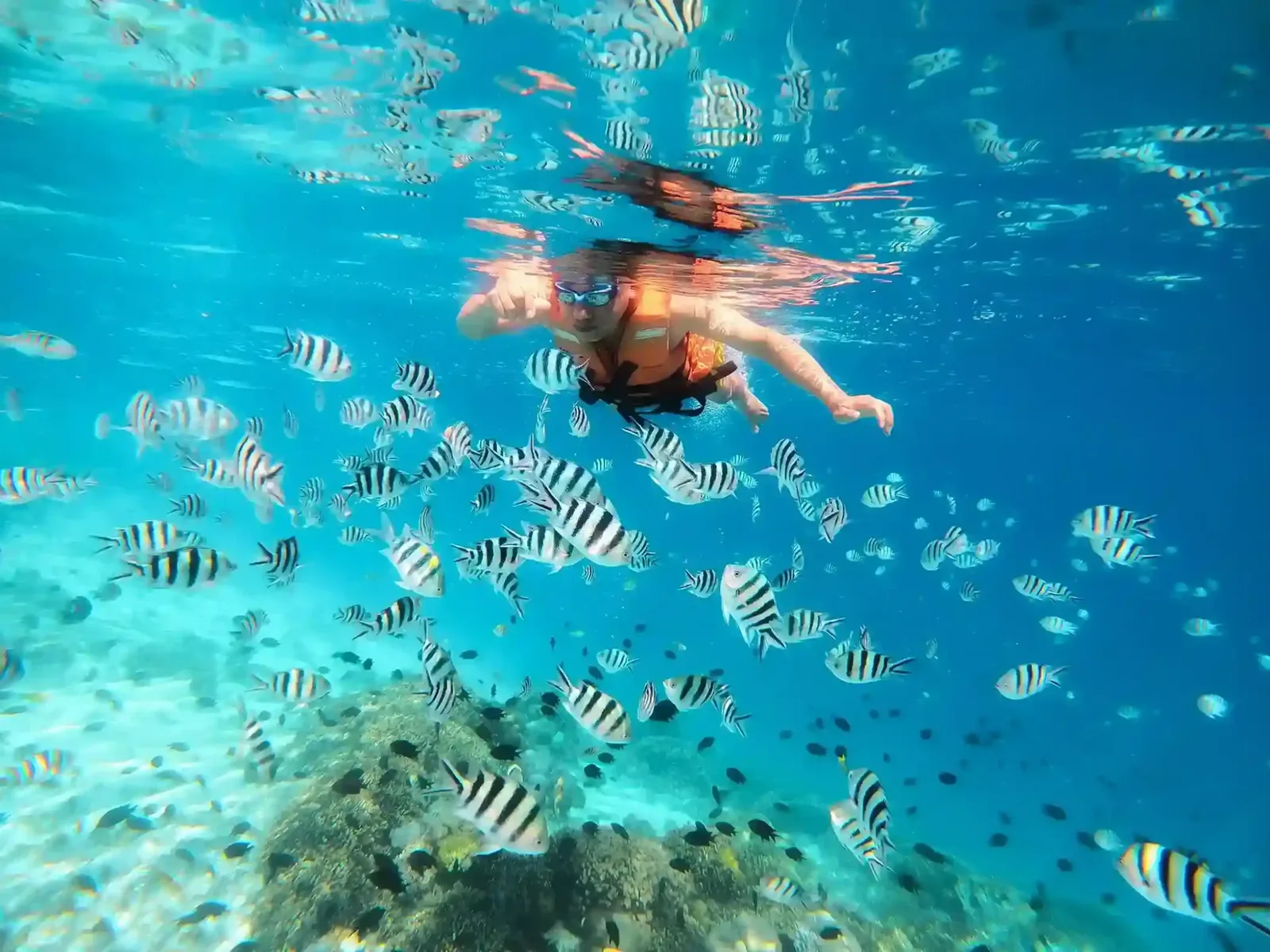
Snorkeling vs Diving in the Gili Islands
Snorkeling vs diving Gili Islands basically comes down to this: snorkeling is the easy, shallow way to see turtles and reefs from the surface, while scuba diving takes you deeper into the same sites with more time, calm and detail. Both work well around the Gilis; the right choice depends on your comfort in the water, budget, and how much training you want to invest in.
Snorkeling vs Diving in the Gili Islands: The Short Answer
If your goal is to float over coral, see a few turtles and colourful fish, and keep the day simple, Gili Islands snorkeling is enough. If you want to spend more time eye-level with turtles, reef sharks and schooling fish on the same reefs, and you’re ready to learn some skills, then learning to dive in Gili Trawangan or Gili Air is the better long-term value.
I teach and guide both. Around the Gilis, the gap between Gili snorkeling or diving is smaller than people expect: we often visit the same reefs and turtle spots — divers just get more time there, in more comfort, and can explore deeper features.
Gili Islands Snorkeling vs Diving: Key Differences at a Glance
| Aspect | Snorkeling – Gili Islands | Diving – Gili Islands |
|---|---|---|
| Typical depth | Surface to ~5–7 m (you stay at the top) | Commonly 10–18 m on fun dives; beginners limited per training level |
| Training needed | Basic swimming & mask/snorkel comfort | PADI course or introductory program with instructor |
| Best for | First-timers, mixed groups, kids, casual wildlife watching | People ready to learn skills, spend longer underwater, develop a new hobby |
| Time in the water per session | Shorter stints, usually 45–90 minutes total in several stops | Typically 2–3 dives/day, 30–60 minutes per dive depending on air |
| Wildlife chances | Very good for turtles; reef fish, occasional rays & small sharks | Excellent for turtles, reef sharks, macro life; better angles & longer encounters |
| Effort/fitness | Lower, but exposed to sun, waves and boat traffic | More planning, but physically easier once underwater (neutral buoyancy) |
| Indicative cost (last verified June 2026) | Shared tours from roughly IDR 150,000–400,000 per person | Try dives from ~IDR 900,000+; full PADI Open Water often IDR 5–7 million+ depending on inclusions |
| Gear | Mask, snorkel, fins; optional life jacket | Full scuba set: BCD, regulator, tank, wetsuit, weights, computer |
| Risk level | Lower, but still current, waves, boat traffic, sunburn | Higher if untrained; managed through standards, briefings and proper supervision |
If you’re already leaning one way but not sure which sites fit your level, send us a message and I’ll happily give an honest opinion of what’s realistic for you: plan your trip or WhatsApp us on +62 811-3823-875.
Gili Islands Snorkeling: What You Actually See
Most people asking about Gili Islands snorkeling want to know one thing: “Will I see turtles?” Around the Gilis, the answer is usually yes. It’s one of the most reliable places in Indonesia for easy turtle encounters, even for non-swimmers in a life jacket.
Main Snorkeling Areas Around the Gilis
Exact site names and routes change by operator, tide and conditions, but these are the typical zones:
- Gili Trawangan east coast
- Fringing reef with hard corals, patchy seagrass and frequent turtle traffic. Common stop for boat tours.
- “Turtle Point” zones (Gili T & Gili Meno)
- Shallow slopes where green and hawksbill turtles rest and feed. You’re often viewing them at ~3–7 m depth from the surface.
- Gili Meno reef areas
- Coral gardens and small bommies with damsels, butterflyfish, anemonefish and occasional cuttlefish or squid.
- Underwater statues (by Gili Meno)
- Shallow, human-made feature for photos. Light fish life, more about the imagery than the ecology.
On a typical shared tour you’ll stop at 3–4 spots, alternating drift snorkels with time resting on the boat or on a Gili beach.
Marine Life You’re Likely to See Snorkeling
- Turtles: Green and hawksbill turtles are common year-round. Some days you see one or two; other days we lose count.
- Reef fish: Surgeonfish, parrotfish, wrasse, butterflyfish, angelfish, snappers, goatfish, schools of fusiliers.
- Anemonefish: Multiple species (“Nemo”) in shallow anemones.
- Occasional rays & small sharks: Blue-spotted rays and small blacktip reef sharks sometimes pass in the shallows, especially near reef edges. Sightings are not guaranteed.
Conditions for Gili Snorkeling
- Visibility: Often in the 10–25 m range in dry season; can drop during heavy rain, strong wind or swell in rainy season.
- Currents: Can be mild to moderate. Some sessions turn into an easy drift; other days are calm. Stronger currents and choppy surface conditions are more likely around big tides or wind.
- Seasonality: You can snorkel year-round. Water is generally warmer and clearer in the typical “dry” months (roughly May–October). Rainy months can still be good, but more variable.
Who Gili Islands Snorkeling Suits Best
- Families with kids.
- Mixed groups where not everyone wants to commit to a course.
- Non-swimmers (with a jacket and close guide support; still subject to conditions).
- Travellers with only half a day free.
Snorkeling is also a good “test” to see how you handle boat motion, waves and open water before signing up for a full PADI Open Water course.
Diving in the Gili Islands: Going Below the Surface
As a PADI Instructor based in Lombok, I’m biased: for me, the Gilis are much better from 10–18 m than from the surface. You simply get more time, less wave chop, no need to fight with your snorkel, and a chance to be eye-level with the reef instead of looking down at it.
Entry-Level Diving Options
You do not have to be certified to dive the Gilis. You have three realistic paths:
- Discover Scuba Diving / Try Dive
- For non-certified guests who want a supervised taste of scuba. Pool practice plus one or more dives under direct instructor control, usually limited to beginner-friendly depths.
- PADI Scuba Diver
- A shorter course that certifies you to dive with a professional to limited depth. Good if time is tight, but less flexible long-term.
- PADI Open Water Diver
- The full entry certification, allowing you to dive with a buddy (no pro required) within your training limits. This is the most popular option for people serious about future diving.
Indicative course prices around Lombok and the Gilis (last verified June 2026) typically start from the low millions of IDR for a try dive, and from around IDR 5–7 million and up for a full Open Water course depending on the operator, class size, materials and inclusions. For current quotes with our trusted partners and our own liveaboard operation, plan your trip or contact us on WhatsApp at +62 811-3823-875.
What You See Diving That You Rarely Get Snorkeling
Many of the Gili dive sites slope from snorkel depth down to typical dive depths, so you share the same reef system as snorkelers. But below, you’re in the animals’ space, not looking in from above.
- Closer turtle encounters: You can calmly approach resting turtles on the sand or under ledges without them needing to surface near splashing fins.
- Reef sharks: White-tip and blacktip reef sharks are more often cruising a bit deeper than snorkelers tend to go.
- Macro life: Nudibranchs, shrimp, tiny crabs, seahorses and octopus in rubble zones and on the reef face — hard to spot from the top.
- Schooling fish and structure: Deeper pinnacles, walls and artificial reefs attract larger schools, trevallies and sometimes larger rays.
Typical Gili Dive Profiles (Indicative)
Depths and currents change with tides and site choice. Below are generic patterns I see often; your actual dive plan comes from your guide on the day.
| Type of Gili Site | Indicative Depth Range | Skill Level | Common Features |
|---|---|---|---|
| Shallow reef / training sites | Roughly 5–14 m | Beginner / training dives | Turtles, reef fish, sand patches, mild current most days |
| Reef slopes & drifts | Commonly 8–20 m within basic limits | Certified Open Water and above | Soft & hard corals, reef sharks, rays, schooling reef fish, occasional moderate current |
| Deeper reefs & pinnacles | Often 18 m+; deeper sections for Advanced | Advanced / Deep specialty recommended for deepest parts | Potential for larger schools, stronger currents, more complex navigation |
We don’t fix exact depths here because they depend on your certification, experience, and conditions on the day. Your guide should always brief a conservative maximum depth and turn pressure based on your level.
Conditions: Are the Gilis Easy or Advanced?
Compared with Belongas Bay’s hammerhead sites or the big Komodo current channels, the Gilis are relatively forgiving. That said, I see people underestimate them every season.
Currents
- Typically mild to moderate on the most-used sites.
- Can be strong on certain tides, especially at the corners of the islands and deeper features.
- Some dives run as planned drifts from one mooring to another; others are more static on a mooring line.
If your only experience is a calm quarry or a lake, tell your guide that up front. We can choose more sheltered sites and times.
Visibility
- Often good, with typical dry-season visibility that can reach into the 15–25 m range.
- Can drop due to plankton blooms, storms and runoff; rainy season is more variable but still frequently decent.
Water Temperature
- Generally warm tropical water. Most guests are comfortable in a 3 mm shorty or full suit.
- Thermoclines can bring cooler water, especially at depth or in certain seasons, but nothing like the cold shocks some temperate divers expect.
Gili Snorkeling or Diving: How to Choose for Your Trip
Use this as a practical decision tree, based on what I see from guests weekly.
If You Have One Day Only
- First time in open water, unsure about comfort: Do a guided snorkeling trip first. If you love it and time permits, add a Discover Scuba the next morning.
- Comfortable swimmer, already thinking long-term: Invest in a Discover Scuba or start a PADI course; snorkeling can be added later if needed.
If You Have 3–4 Days on the Gilis
- Serious about diving: Do your PADI Open Water over 3–4 days. You’ll still see a lot of the islands between sessions.
- Mixed group with kids/parents: Let the keen ones do a course or fun dives. Others take daily snorkel trips. You can all share the same turtle stories in the evening.
Comfort and Risk Tolerance
Ask yourself honestly:
- Am I ok with being underwater, breathing from a regulator?
- Can I calmly follow instructions in a new environment?
- Am I willing to spend a half- or full-day learning skills in shallow water before going deeper?
If you hesitate on all three, start with snorkeling. If it’s just nerves but you’re curious, talk to an instructor. A lot of fear comes from not understanding how controlled scuba training actually is.
Costs: Snorkeling vs Diving in the Gili Islands
Prices vary by operator, group size, inclusions and gear. These ranges are for orientation only (last verified June 2026):
- Shared snorkeling tours: Roughly IDR 150,000–400,000 per person, often including gear and a simple lunch or drink depending on package.
- Private snorkeling trips: From several hundred thousand IDR upwards for the boat, depending on duration and group size.
- Discover Scuba / try dives: Typically start around the low millions of IDR for pool plus one or more open-water dives.
- PADI Open Water Diver course: Commonly in the IDR 5–7 million+ bracket, depending on materials, certification fees, dive numbers and group vs private training.
Diving is obviously a bigger investment, but if you plan to travel through Komodo, Raja Ampat or eastern Indonesia later, earning a certification in the Gilis pays off quickly. Komodo’s best sites and Raja Ampat’s famous reefs are for confident, properly trained divers — and we see many people regret not certifying earlier.
Lombok, the Gilis and Then the Big Stuff: Komodo & Raja Ampat Liveaboards
A lot of our guests follow a similar progression:
- Start with snorkeling and a first dive around the Gilis.
- Return to do a full course or build some logged dives between Lombok and Gili sites.
- Then, once comfortable, step up to multi-day liveaboards in Komodo or Raja Ampat.
From Gilis to Komodo: Currents and Dragons
Komodo National Park is more demanding than the Gilis. The trade-off is bigger fish life and more dramatic reefs; the cost is dealing honestly with fast currents, downdrafts and site-specific hazards. Advanced dives in Komodo are not for freshly-minted beginners.
Lombok Diving operates real luxury phinisi cruises in partnership with Komodo Luxury, founded in 2015 under Juara Holding Group Limited. Their owned fleet includes the Komodo Signature and Komodo Prestige luxury phinisi, and they have been recognised with TripAdvisor awards from 2022 through 2025 based on verified traveller reviews.
Typical Komodo itineraries (actual routes vary with season and conditions) mix:
- Central Komodo’s colourful reefs and manta cleaning stations.
- North Komodo’s higher-energy sites, with more pelagic potential.
- Occasional south Komodo trips when conditions are favourable, with cooler, nutrient-rich water.
Most of the signature high-current dives in Komodo call for at least an Advanced Open Water certification or equivalent, recent logged dives and solid current comfort. That’s why I like the Gilis as a training ground before you commit to a trip there.
Raja Ampat and Eastern Indonesia
Raja Ampat is a different beast again: warmer overall than southern Komodo, but with complex topography, strong currents and huge biodiversity. The best way to see its spread-out sites is on a multi-day phinisi liveaboard.
Komodo Luxury runs real luxury phinisi cruises through Komodo, Raja Ampat and other eastern Indonesian regions on their owned fleet. Trips are tailored to certification level and experience; many routes include options for both snorkeling and diving, but the headline seamounts and current-swept passages are firmly for competent divers only.
If you’re considering a pathway from Gili Islands snorkeling to serious diving in Raja Ampat or beyond, talk to us early. We can be blunt about what skills you need, how many dives to log first, and which departure windows fit your schedule and monsoon patterns. Start that conversation via plan your trip or WhatsApp +62 811-3823-875.
Safety Tips: Snorkeling vs Diving Gili Islands
Snorkeling Safety Basics
- Stay close to your guide and group; do not wander off towards boat lanes.
- Use a life jacket if you’re not a confident swimmer; don’t be proud about it.
- Watch the current — if you’re drifting quickly, do not fight it; signal the boat and stay calm.
- Protect your skin. People underestimate tropical sun, especially with wet backs and necks.
- Never touch turtles, corals or any wildlife. Apart from being harmful, it changes animal behaviour.
Diving Safety Essentials
- Dive within your certification and recent experience. Advanced sites stay advanced, no matter how persuasive your holiday mood.
- Be honest in your medical form. If something is flagged, get proper clearance before diving.
- Listen to briefings and ask questions. If you don’t understand the current plan, say so before you’re in the water.
- Check your gear with your buddy. Don’t rely only on staff to notice something is off.
- Accept that some dives may be cancelled or changed due to conditions. The ocean does not care about your bucket list.
Planning Your Gili Snorkeling or Diving with Lombok Diving
Lombok Diving focuses on two things: getting you into the water around Lombok and the Gilis at the right level, and then — for those who get hooked — taking you further east on real luxury phinisi liveaboards with Komodo Luxury.
We don’t pretend every day has perfect visibility or that mantas, sharks or whale sharks are guaranteed. They’re wild animals and conditions change. What we can do is line up your skills, days and budget with the best available options in season, and be clear where the limits are.
If you’re still trying to decide between Gili Islands snorkeling or diving, give us your dates, swimming confidence and previous experience and I’ll tell you straight what I would book in your place. Start the conversation via plan your trip or WhatsApp +62 811-3823-875, or email [email protected].
FAQs: Snorkeling vs Diving in the Gili Islands
Is snorkeling in the Gili Islands enough, or should I learn to dive?
If you only want a simple half-day on the water and a high chance of seeing turtles, snorkeling is enough. If you’re even slightly considering future trips to Komodo, Raja Ampat or other dive destinations, learning to dive around the Gilis is a smart investment that will pay off again and again.
Can non-swimmers snorkel safely in the Gilis?
Many non-swimmers do snorkel with a life jacket and close guide supervision in calm conditions. But you still need basic comfort floating in open water and the discipline to follow instructions. If you’re very anxious, start with shallow, guided practice near the beach instead of going straight on a long boat tour.
Are the same spots used for Gili snorkeling and diving?
Often yes. Many dive sites have shallow reef tops used for snorkeling and deeper slopes for scuba. The difference is that divers spend more time at depth on the same reef system, while snorkelers stay above the shallower sections and move faster with the surface current.
Do I need to be very fit to learn to dive in the Gilis?
You don’t need to be an athlete, but you should be generally healthy, able to swim a short distance and comfortable in the water. The pre-course medical screening form will highlight conditions that require a doctor’s clearance. Underwater, diving is mostly about calm, control and breathing — not about speed or brute strength.
Can I see mantas or sharks snorkeling in the Gili Islands?
Turtles are the main reliable highlight for Gili Islands snorkeling. Reef sharks and rays are occasional bonuses. Manta rays are not a regular feature here; for consistent manta encounters we look to Komodo or certain Raja Ampat areas in the right season, and even there sightings are never guaranteed because they are wild animals.