
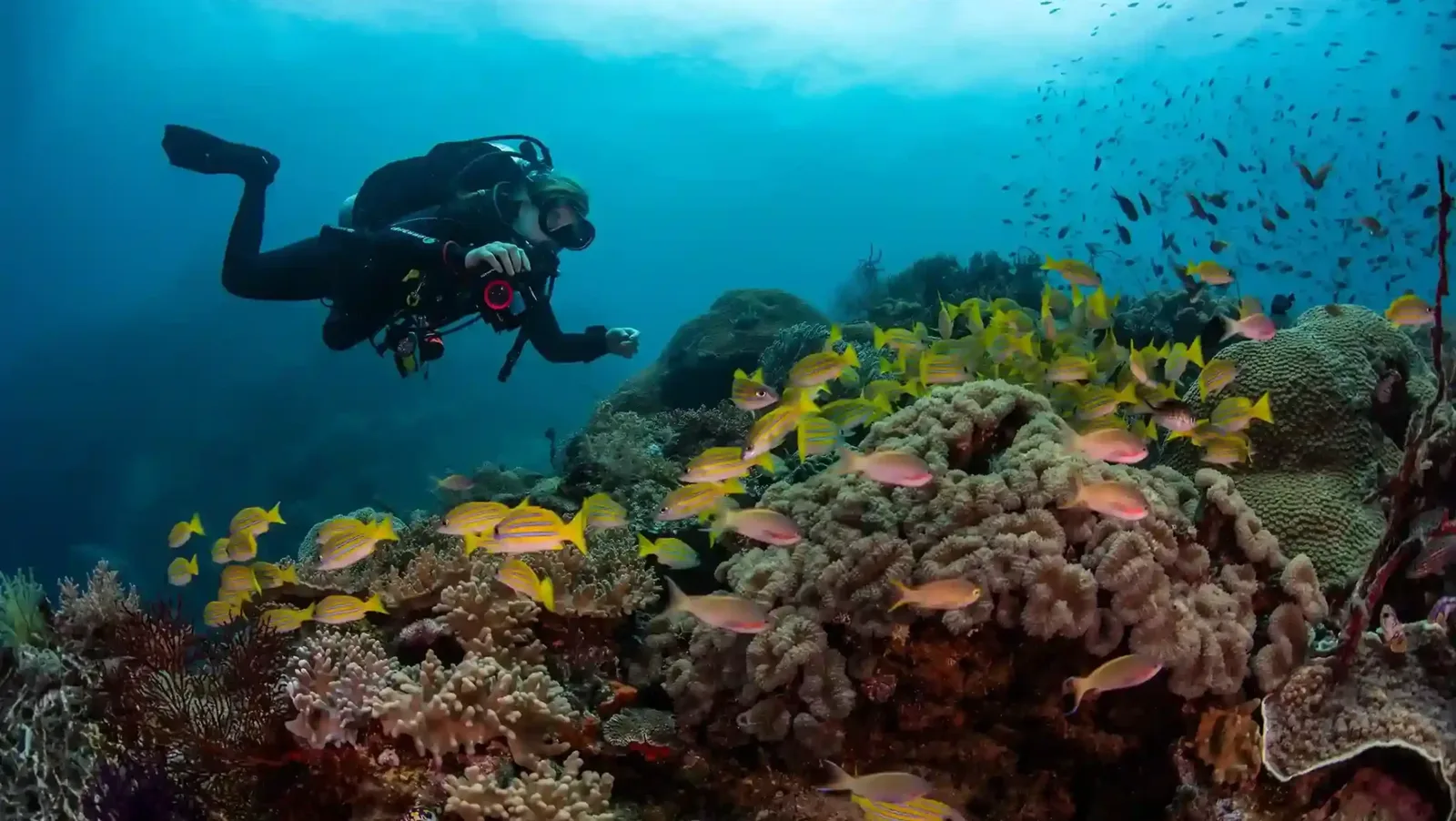
Underwater Photography in Lombok & Komodo
Underwater photography Lombok Komodo means using a camera system to record the reefs, pelagics and macro life around Lombok, the Gili Islands and the Komodo National Park under real-world dive conditions. In practice, it combines local site knowledge, honest assessment of currents and visibility, and solid buoyancy so your images improve without damaging coral or needing risky dives beyond your training.
As PADI instructors and local guides at Lombok Diving, we see the same pattern every week: photographers arrive with good gear but no clear plan for sites, seasons or skill progression. This guide is the plan I wish every underwater shooter had before stepping off the boat in Lombok or boarding a Komodo Luxury phinisi.
Why Lombok & Komodo Work So Well for Underwater Photography
Lombok and the Gili Islands give you easy, repeatable practice dives and productive macro photography Lombok sessions. Komodo adds the big action: mantas, sharks, schooling fish and dramatic topography.
Both belong to the Coral Triangle, so you get:
- High coral diversity
- Year‑round diving (with seasonal shifts in visibility and temperature)
- Mix of gentle slopes, walls, and current-swept channels
Komodo, especially, is not a casual photo destination. Many of the classic wide‑angle sites require good current management, tight buoyancy and the right certification level. Some dives are not safe places to “test a new housing”.
Core Regions at a Glance for Dive Photography Indonesia
Illustrative, not exhaustive. Depths and conditions are indicative only; they vary by day, tide and season.
| Region | Typical Focus | Indicative Depth Band (m) | Recommended Minimum Level | Notes for Photographers |
|---|---|---|---|---|
| Gili Trawangan / Air / Meno (Lombok) | Turtles, reefs, schooling fish, entry‑level wide‑angle | 5–25 | Open Water or higher | Gentler conditions at many sites; good for learning camera and buoyancy. |
| Southwest Lombok (Sekotong zone) | Reefs, occasional pelagics, some macro | 5–30 | Advanced Open Water helpful | Less traffic; timing important for visibility and current. |
| Belongas Bay (Lombok) | Sharks, schooling fish, seasonal hammerheads | Roughly mid‑20s and deeper | Advanced + solid experience in current | For experienced divers only; often rough surface and strong current. |
| North Komodo (around Gili Lawa area) | Mantas (in season), big schools, vibrant reefs | Shallow manta tops to deeper walls | Advanced; experience in current | Strong currents common; follow guide briefings precisely. |
| Central Komodo | Mixed: macro, reefs, mantas (in season) | 5–30+ | Advanced recommended | Classic wide‑angle; some calmer macro bays for longer bottom times. |
| Southern Komodo / Rinca | Soft corals, cooler water, macro + wide | 10–30+ | Advanced; comfortable with thermoclines | Cooler water and lower vis can give very rich colour and critters. |
| Raja Ampat (liveaboard extensions) | Reefs, schools, mangroves, macro | 5–30+ | Advanced recommended | Diverse shooting; requires liveaboard logistics and good situational awareness. |
For detailed regional diving info, see our main guide to Lombok & Gili diving, then build your dive plan around the photo subjects you care about most.
Gear: What Actually Matters in Lombok & Komodo
You can shoot good images here with anything from an action cam to a full-frame rig, but local conditions favour certain choices.
Housings, Lenses & Ports
- Compacts / action cams
- Excellent for first‑time shooters on Gili reefs and calm Lombok sites.
- Use a red filter or manual white balance in available light down to moderate depths.
-
Add a small video light if you want usable colour on close subjects.
-
Mirrorless / DSLR
- Wide‑angle zoom or fisheye for reefs, turtles and mantas in Lombok and Komodo.
- Macro lens for nudibranchs, shrimps and pygmy seahorses on calmer sites.
- Dome ports work well for shallow wide‑angle; flat ports for macro and medium‑range fish portraits.
Lighting: Strobes vs Video Lights
- Strobes
- Best for stills: freeze motion in current, maintain colour.
-
Two mid‑power strobes are ideal, but one is fine if you keep subjects close.
-
Video lights
- Great for night dives, macro focus and hybrid shooting.
- In Komodo’s stronger currents, a powerful video light helps for quick focus and backup if a strobe misfires.
Skills to Prioritise Before Adding More Gear
Spend your first Lombok dives using simple equipment and nailing:
-
Neutral buoyancy within 0.5 m
– You should be able to hover without sculling your hands or finning constantly.
– Practice on calm Gili sites before carrying a big rig into current. -
Back‑kick and helicopter turns
– Very useful for framing shots without touching coral.
– Your guide can show you quick drills at the safety stop. -
Situational awareness
– In Komodo, losing track of the group because you are buried in the viewfinder is not acceptable.
– Agree clear signals with your guide for “stop shooting and move”.
If these are not yet solid, focus your underwater photography Lombok Komodo plan on easy Gili / Lombok sites first, or ask about a photography‑friendly Advanced Open Water progression.
Lombok & Gili: Perfect Training Ground for Underwater Photography
Gili Islands – Practice and Portfolio in One
The Gilis (Trawangan, Air, Meno) are ideal for building skills:
- Gentler sites: Several reefs have manageable currents and comfortable depths for Open Water divers.
- High turtle density: Green and hawksbill turtles are common; great for learning approach and composition.
- Predictable conditions: Visibility is often good, with seasonal variation rather than daily extremes.
Typical plan for new shooters:
- Day 1–2: Shallow reef dives with a compact or simple mirrorless setup.
- Day 3+: Add strobes, experiment with manual exposure, and repeat the same sites to see improvement.
Macro Photography Lombok: Where to Look
True “muck” sites are more famous elsewhere in Indonesia, but Lombok does offer useful macro options:
- Protected sandy patches near reefs
- Rubble slopes with soft corals, feather stars and hydroids
- Night dives highlighting shrimps, crabs, flatworms and nudibranchs
Tell your guide you want macro photography Lombok sessions: we can adjust profiles (shallower, slower, smaller search area) and group you with similarly focused divers when possible.
Belongas Bay: Leave the Big Camera Until You’re Ready
Belongas Bay in southwest Lombok is known for:
- Strong currents and down‑currents
- Often choppy surface conditions
- Sharks, schooling fish and seasonal hammerhead encounters
For photographers, that combination is tempting but risky.
Blunt advice:
- Do not treat Belongas as a camera testing ground.
- Minimum: Advanced certification, recent experience in current and deep dives, and comfort with rolling entries in swell.
- Start with a streamlined setup; leave the monster dome and twin strobes on shore until you understand the site.
We will say no to divers whose training or recent dive history does not match conditions. A camera does not change that.
Komodo from a Liveaboard: Why Phinisi Cruises Work for Photography
Lombok gives you repetition and comfort. Komodo adds variety and big subjects, which is where real luxury phinisi dive cruises come in.
Komodo Luxury operates high‑end phinisi liveaboards across Komodo, Raja Ampat and eastern Indonesia, including the Komodo Signature and Komodo Prestige. Founded in 2015 under Juara Holding Group Limited, they have consistent recognition from TripAdvisor Travelers’ Choice awards for 2025 and 2026. That matters: stable operations, trained crews and dive teams who understand photographers’ needs.
Advantages for Photographers
- Multiple dives per day – You can repeat a manta site or macro bay in different light.
- Flexible schedules – Good captains and cruise directors shift timings to avoid crowds and match tides.
- Dedicated camera tables and rinse tanks – Standard on serious dive liveaboards; ask your agent for exact facilities.
Indicative trip pricing (last verified June 2026) for luxury phinisi itineraries typically ranges from mid‑to‑upper four figures USD per person for a week‑long cruise, depending on season, boat and cabin type. For a current quote and photo‑friendly itinerary, plan your trip or message the team directly on WhatsApp at +62 811-3823-875.
Seasons, Visibility & Wildlife Reality Check
Lombok & Gili Seasons
- Diving is year‑round.
- Visibility and surface conditions shift with the monsoon cycle.
- Some months bring slightly cooler water and potentially better visibility; others bring more plankton and softer light for photography.
Komodo Seasons
In Komodo:
- Water temperatures swing from warm to notably cooler, especially in the south.
- Visibility can range from crystal clear to plankton‑rich “green” water that mantas enjoy.
- Strong currents are not a “sometimes” thing, they are built into the ecosystem.
For mantas, sharks and other pelagics:
- They are wild and seasonal. There are periods with higher probability at certain sites, but nobody honest will promise a manta on a specific dive or a hammerhead on a specific day.
- Good guides and liveaboard routing improve your odds by reading conditions and recent sightings, not by offering guarantees.
Practical Shooting Strategies in Lombok & Komodo
Wide‑Angle (Reefs, Turtles, Mantas, Schools)
- Lombok & Gili
- Stay slightly above turtle eye level; do not chase or block their ascent.
-
Ask your guide to point out coral bommies or sea fans that frame subjects naturally.
-
Komodo
- For mantas, position where guides brief you; do not camp directly on cleaning stations.
- In current, angle your body and housing slightly into the flow; use the current to bring subjects past you rather than swimming against it.
Macro & “Fish Portraits”
- Start in calmer Lombok bays and reef edges.
- Keep your lens within 30–40 cm of the subject for better colour and sharpness.
- Minimise fin movement near sand to avoid backscatter.
Night Photography
Lombok and Komodo both offer productive night dives:
- Check with the cruise director or dive centre about local rules and suitable sites.
- Drop shutter speed a little for ambient background, but avoid so slow that you blur even with strobe.
- Focus lights can agitate some subjects; reduce intensity or angle the beam slightly away.
Training & Courses: Get the Skills First
At Lombok Diving and on Komodo Luxury cruises, we see two pathways that work:
1. Build Foundations in Lombok
- Finish PADI Open Water in calm Gili conditions.
- Add PADI Advanced Open Water with a photography‑friendly instructor.
- Log 20–30 dives in mixed conditions before planning Komodo.
Use Lombok to:
- Practice camera handling without stress.
- Learn current etiquette.
- Understand your air consumption so you know how long your photo windows really last.
2. Join an Advanced‑Friendly Liveaboard
If you are already:
- Comfortable at depth.
- Used to currents and liveaboard routine.
- Confident with your camera system.
Then a Komodo or Raja Ampat itinerary on Komodo Signature or Komodo Prestige makes sense. Still, listen carefully to the cruise director: some high‑energy sites are better done with minimal camera bulk.
For personalised training or to combine a Lombok land‑based progression with a Komodo liveaboard, plan your trip or reach out via WhatsApp at +62 811-3823-875 or [email protected].
Safety, Etiquette & Conservation for Photographers
A few non‑negotiables:
- No touching coral or animals. Damaged reefs make terrible backgrounds, and harassment changes animal behaviour.
- Stay with the group. In Komodo especially, your guide sets limits based on currents, not on your memory card space.
- Agree lost‑buddy and low‑on‑air protocols before the dive. Cameras make people forget basic checks.
- Streamline your rig. Secure dangling arms, focus lights and gauges to avoid entanglement or coral contact.
Responsible photographers are welcome on our boats. Those who treat reefs and animals as props are not.
Working With Lombok Diving & Komodo Luxury
Lombok Diving focuses on:
- Daily dive trips and courses around Lombok and the Gili Islands.
- Honest briefings about conditions, experience requirements and realistic wildlife expectations.
- Small guided groups, with the option to orient dives for photography where conditions and group dynamics allow.
Komodo Luxury focuses on:
- Premium Indonesia liveaboards on luxury phinisi yachts, currently including Komodo Signature and Komodo Prestige.
- Carefully planned itineraries across Komodo, Raja Ampat and other eastern Indonesia regions.
- Consistent operations, recognised by TripAdvisor Travelers’ Choice awards for 2025 and 2026.
If you proceed with our partner they may pay us a referral fee at no extra cost to you.
To connect your Lombok training with a liveaboard expedition, ask us to align dates and routes so your underwater photography Lombok Komodo plan feels like one coherent project instead of two separate trips.
FAQs
Do I need to be an advanced diver to do underwater photography in Lombok?
No. Many Lombok and Gili sites are suitable for Open Water divers and are perfect for learning camera skills. Advanced certification is strongly recommended for Belongas Bay and for most Komodo liveaboard itineraries because of depth and current.
Can I bring a large DSLR rig on Komodo dives?
Yes, if your buoyancy and current skills are solid. On very high‑energy sites, guides or cruise directors may advise a simplified setup for safety. Listen to them; some dives are primarily about safe navigation in current, not photography.
What’s the best time of year for underwater photography in Komodo?
Komodo is diveable year‑round, with different areas performing better in different months. Some periods bring clearer water; others bring more plankton and higher manta probabilities. Wildlife is seasonal and wild, so no responsible operator can guarantee specific encounters on specific dates.
Is rental camera gear available in Lombok?
Basic systems such as action cameras or compact cameras in housings are often available; advanced rigs are usually personal equipment. Contact us ahead of time via WhatsApp or email so we can confirm what is currently on hand and reserve what you need.
How much does a Komodo liveaboard for photographers cost?
Luxury phinisi trips with Komodo Luxury typically fall in the mid‑to‑upper four figures USD per person for around a week, last verified June 2026. Exact pricing depends on season, cabin category and itinerary. For a tailored quote and photo‑oriented advice, plan your trip or message +62 811-3823-875.